

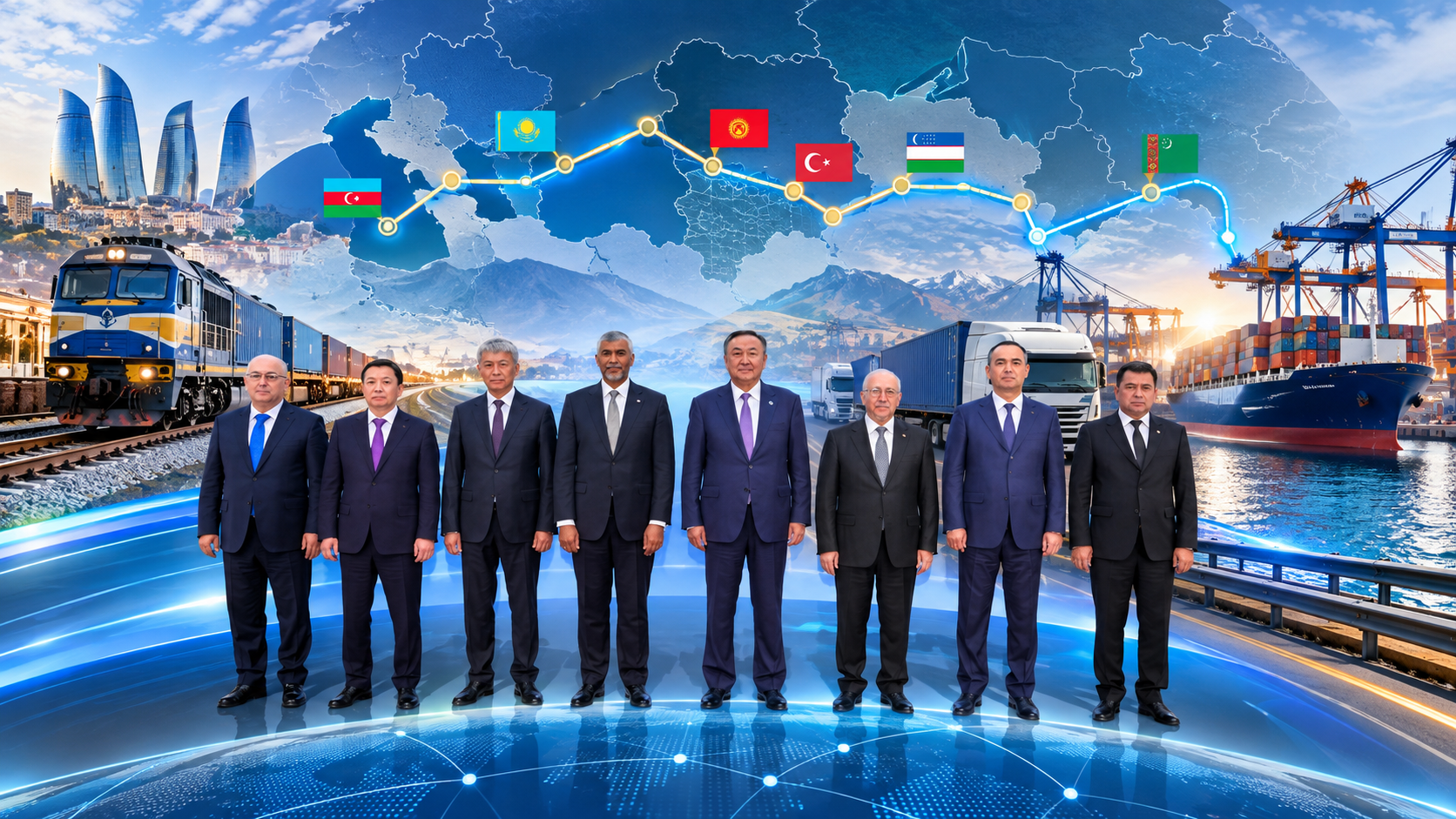
Customs services of the member states of the Organization of Turkic States have agreed to accelerate the digitalization of procedures and introduce electronic data exchange. The new measures are intended to simplify customs clearance for businesses and international carriers and reduce cargo delivery times between countries, according to infohub.kz.
The agreements were reached in Bishkek at the 12th meeting of the heads of customs administrations of the OTS member states. The delegation of the State Revenue Committee of the Ministry of Finance of the Republic of Kazakhstan was led by Committee Chairman Zhandos Duisembiev.
The meeting was chaired by the head of the State Customs Service of the Kyrgyz Republic, Ulan Kimsanov. It was attended by the heads of the customs services of Azerbaijan, Kazakhstan, Turkey, and Uzbekistan, OTS Secretary General Kubanychbek Omuraliev, and World Customs Organization Secretary General Ian Saunders. Representatives of the State Customs Service of Turkmenistan and the International Road Transport Union (IRU) also took part.
"One of the main outcomes of the meeting was agreements on digital information exchange, simplification of customs procedures, and development of transit routes. By March 1, 2027, the customs services plan to complete the implementation of the technical conditions for information exchange under the Agreement on the Creation of a Simplified Customs Corridor," the State Revenue Committee of Kazakhstan said.
After that, the OTS countries will be able to move to a pilot electronic data exchange between customs administrations. The official launch of the pilot project is planned for the next meeting of the heads of customs services, which will be held in Turkey.
"For businesses and international carriers, digital data exchange should make customs procedures more efficient and reduce cargo delivery times between countries. Automation of interaction is also seen as one of the tools for further simplifying international trade and transit," the agency explained.
Participants paid special attention to customs risk management and cooperation between customs laboratories. By December 1, 2026, countries must submit proposals on relevant areas for exchanging experience. After that, the OTS Secretariat will compile a consolidated list of such areas.
Kazakhstan and Uzbekistan presented their experience of bilateral cooperation between customs laboratories and invited other OTS states to join this interaction.
"The meeting also agreed on a phased schedule for preparing the Action Plan, or 'road map,' for OTS customs cooperation for 2027–2031. In addition, the preparation of a Memorandum of Cooperation in the field of authorized economic operator programs is envisaged," the SRC added.
Participants also discussed other areas of digitalization and simplification of transportation. These include the introduction of the eTIR procedure, development of the single window principle, and use of the Trans-Caspian Customs Transit Portal.
The implementation of these decisions should speed up the passage of goods across borders, improve the efficiency of customs procedures, and strengthen the transit potential of the Organization of Turkic States.
"This is of particular importance for the development of the Middle Corridor, which connects the markets of Asia and Europe via the Caspian Sea," the State Revenue Committee of Kazakhstan emphasized.
Following the meeting, the parties signed a protocol consolidating the agreements reached and the timelines for their implementation.
The next, 13th meeting of the heads of customs administrations of the OTS member states will be held in 2027 in the Republic of Turkey.