

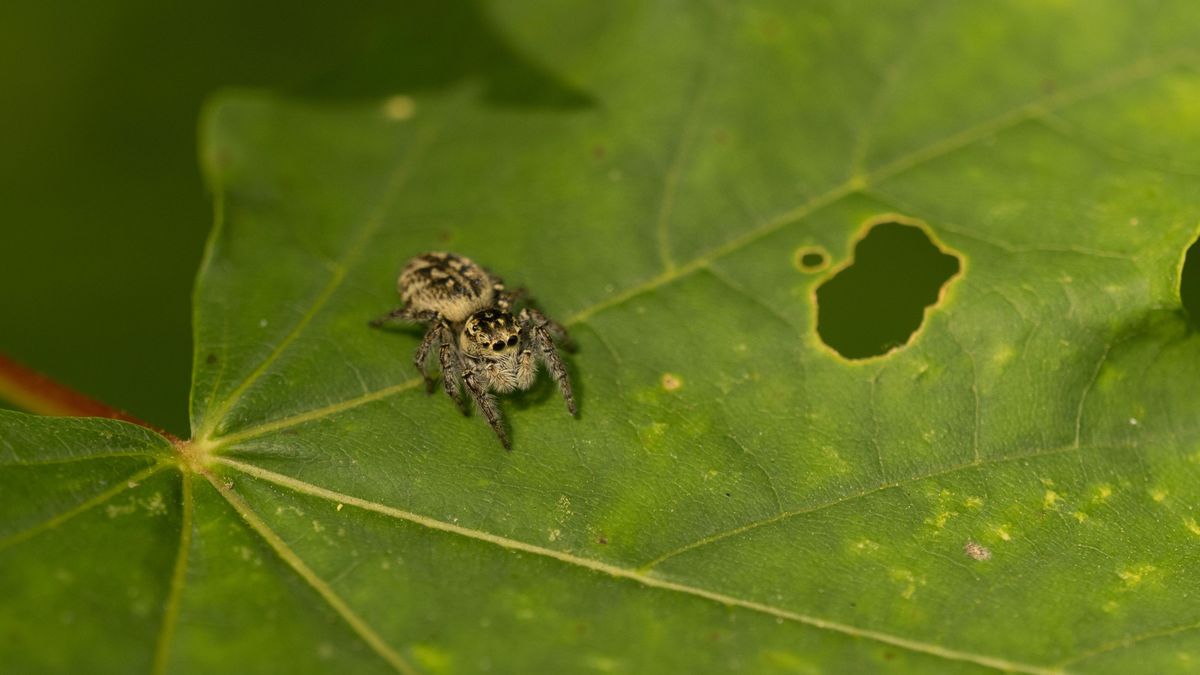
Spiders do not simply freeze in place to rest — they pass through full sleep stages similar to the dreaming phase in humans, the website infohub.kz reports.
Researchers at the University of Bonn studied in detail the behavior of the Australian jumping spider Portia fimbriata. This predator, about the size of a small coin, is known for its complex hunting behavior: it specializes in catching other spiders and can lure victims by mimicking the vibrations of trapped insects. The species' high cognitive abilities made it an excellent candidate for studying how the nervous system works during rest.
Continuous infrared camera footage showed that spiders' sleep is divided into two distinct stages. In one of them, scientists recorded regular muscle twitches and active eye movements. This state closely resembles the REM phase (rapid eye movement sleep) in vertebrates and humans, during which people experience vivid dreams.
To prove that the spiders were actually sleeping rather than merely sitting motionless, the authors tested their response to external sound stimuli and conducted a series of sleep-deprivation experiments. After being forced to stay awake, the arthropods compensated for the lack of rest with deeper and longer sleep.
The discovery shows that complex sleep mechanisms emerged at the earliest stages of evolution, long before the appearance of mammals.