

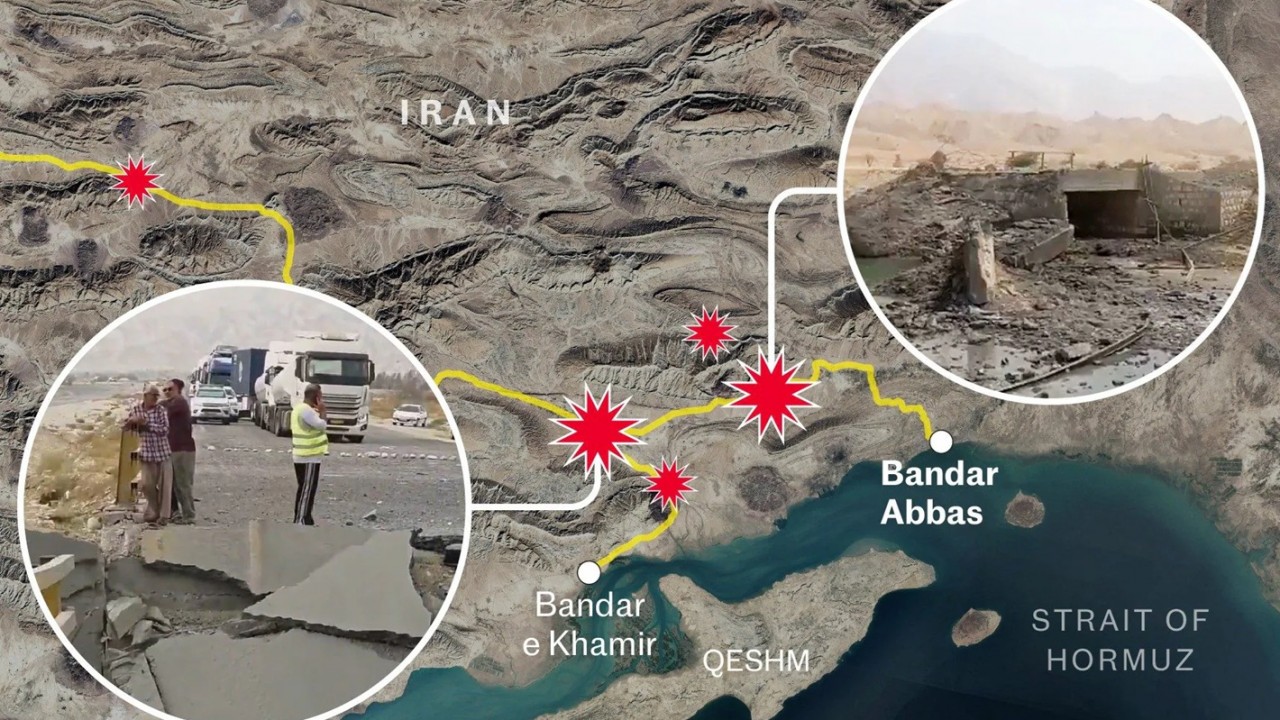
One of Iran's main ports, Bandar Abbas, has been effectively cut off from inland regions after US strikes on bridges, railways, and logistics infrastructure, reports infohub.kz.
Bandar Abbas, home to about 500,000 people, found itself under transport blockade after a series of American bombings. The strikes hit facilities connecting the southern coast to the rest of the country. Local authorities said key bridges were destroyed or damaged.
By Friday morning, road routes leading from Bandar Abbas to other parts of the country were severely damaged. The railway line was partially knocked out, and the port, which supplies goods for roughly 90 million people, was effectively isolated.
Bandar Abbas handles about 85% of Iran's container traffic and roughly 70% of its transit trade. Through the nearby Shahid Rajaee port passes nearly half of the country's total trade, including industrial equipment, construction materials, agricultural products, consumer goods, steel, fertilizers, and petroleum products.
Beyond its economic significance, the city holds a strategic military role. It hosts Iran's main naval base, which controls the Strait of Hormuz.
Local authorities reported damage to five bridges, including the Gariveh bridge on the Bandar Abbas–Khamir–Lar route, a crossing after Latidan village, two bridges on the Kahorestan–Lar road, an unfinished bridge on the Bandar Khamir–Keshar road, and a crossing at Maro village in the Khamir district. On surviving sections, traffic slowed significantly. Officials urged residents to avoid unnecessary travel and keep roads clear for emergency services.
Rail infrastructure was also hit. The Bandar Abbas junction, about six miles west of the city, was damaged. It serves passenger routes, freight lines, and the connection to Shahid Rajaee port. The attack wounded two people, and train passengers were transferred to intercity buses.
Bandar Abbas lacks centralized gas supply, so many households use gas cylinders. Iran's national energy company, Tavanir, acknowledged damage to the southern power grid and said repair crews are working around the clock. After the damage, some roads were rerouted, but US forces are reportedly seeking to again limit logistics recovery efforts.
Sina Toosi, an analyst at the Center for International Policy, said Iranian experts see three possible objectives for the operation around Bandar Abbas. The first is to prepare conditions for a potential military operation. The second is to reduce supply capabilities for Iranian forces tied to controlling the Strait of Hormuz. The third is to increase pressure on the population in hopes of stoking internal discontent with the government.
The strikes hit an economy already weakened by sanctions and military spending. Official inflation in Iran stands at about 60%, with price hikes felt even more acutely. The steel, petrochemical, and industrial sectors are under pressure, and the national currency reacts to every new escalation.