

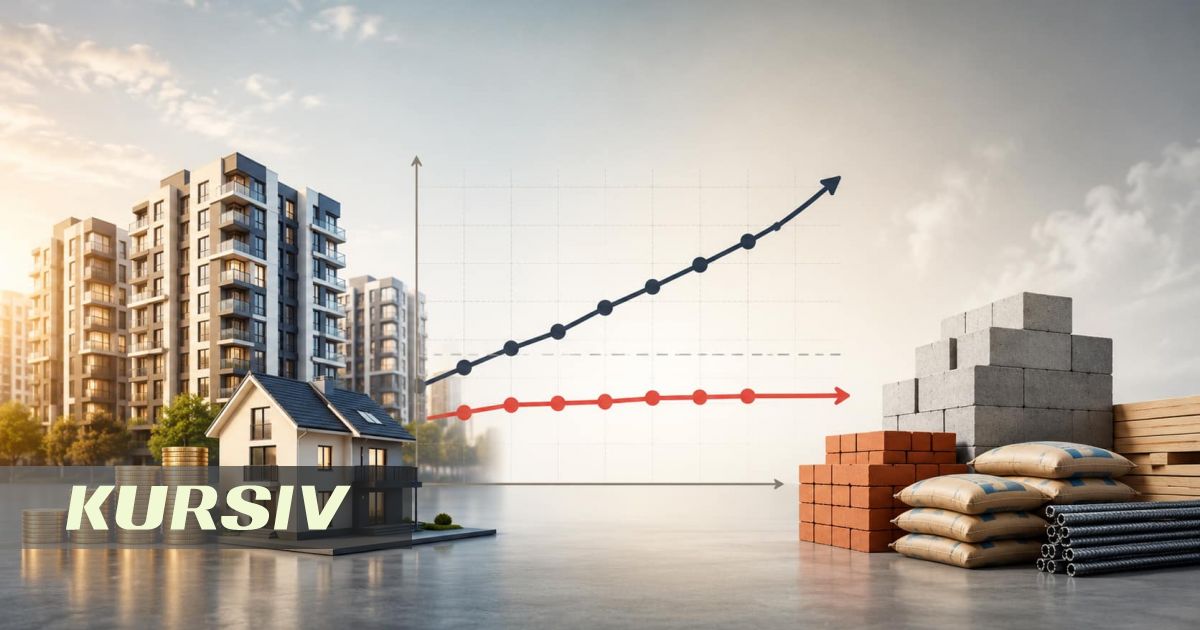
Housing prices in Kazakhstan are rising almost twice as fast as cement prices and more than twice as fast as construction costs, debunking the widespread belief that the surge in construction material costs is the main driver of real estate inflation, reports the website infohub.kz.
The Kazakh Research and Design Institute of Construction and Architecture analyzed project estimates for residential complexes built using monolithic frame technology, the most common method in Kazakhstan. The study found that constructing one square meter requires 219 kg of cement, equivalent to 4–5 bags of 50 kg. With an average retail price of 2,000–2,500 tenge per bag, cement costs amount to about 13,000 tenge per square meter. This means cement's share in construction costs is small and cannot significantly influence the final price. Even a 15–20% rise in cement prices would increase construction costs by only fractions of a percent.
According to Krisha.kz, the average price per square meter in new buildings as of June 2026 is 617,555 tenge. Cement accounts for about 2% of that price. This confirms the divergence in growth rates: since December 2020, finished housing prices have risen 74.8%, factory-gate cement production costs 53.9%, ex-factory cement prices 34.6%, and construction costs only 28.3%.
It is important to note that the construction cost index does not include developer profit, as stated in paragraph 9 of the Methodology for Constructing Price Indices in Construction (Order No. 315 of the Chairman of the Committee on Statistics, Ministry of National Economy of the Republic of Kazakhstan, dated December 14, 2016). The index reflects only production costs—materials, labor, overhead—but not developer margins, which constitute a significant part of the final housing price. Therefore, construction cost growth should not be equated with market price growth.
A recent claim has emerged that housing prices could rise due to restrictions on imports of construction materials from non-EAEU countries. However, cement's share in the final price is negligible. Moreover, production statistics show a positive impact of the ban on the manufacturing sector. In January–June 2026, portland cement production in Kazakhstan reached nearly 7 million tons, up 5% from the same period in 2025. This is the best first-half result since 2008. The trend confirms the industry's ample capacity—over 18 million tons per year—and the timeliness of the ban, which supported domestic industry and preserved jobs. These achievements were made possible through measures by the Ministry of Industry and Construction of Kazakhstan aimed at developing the manufacturing sector and increasing domestic production of construction materials.
The real reason for price growth is a housing deficit. Housing provision in Kazakhstan stands at 24.5 square meters per person, compared to the UN standard of 30 square meters. Each Kazakhstani has 0.8 rooms, against the OECD standard of 1.7. By these indicators, the country lags developed nations by 30–50%. It is this structural shortage of housing stock, not fluctuations in cement prices, that creates long-term pricing pressure on the real estate market.