

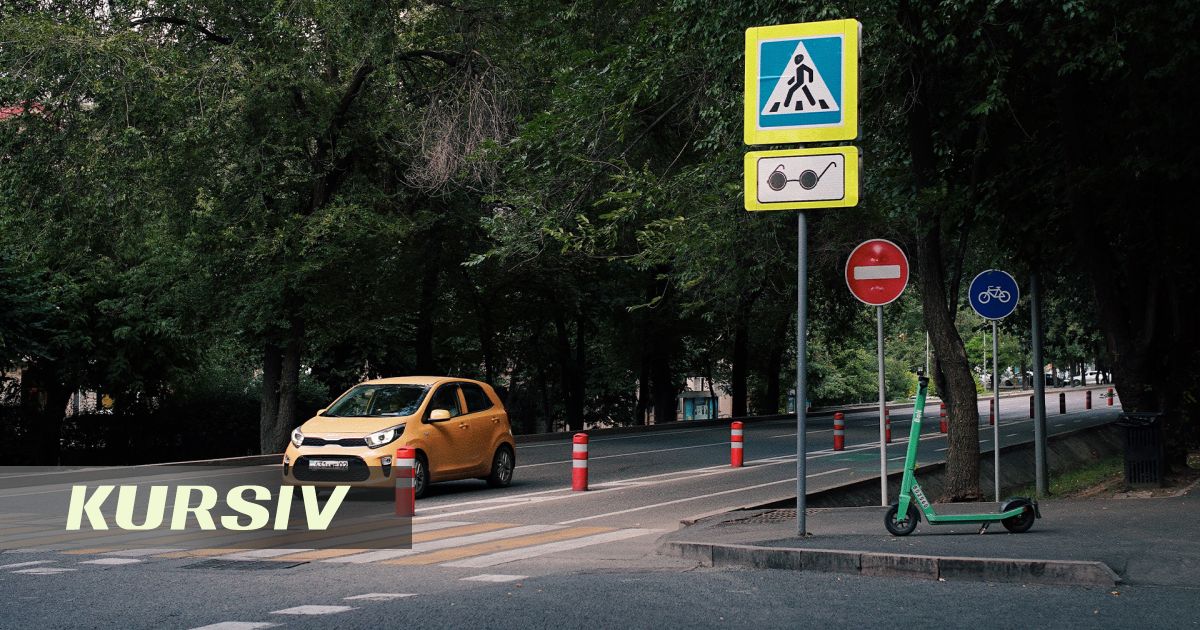
A Tyumen journalist and road traveler, Anatoly Kuznetsov, was impressed by the calm driving style and adherence to speed limits in Kazakhstan, reports infohub.kz.
According to him, the difference is noticeable immediately after crossing the border, and he believes it's due to hefty fines. "I have never felt so safe behind the wheel as I do here," the journalist said. On Kazakh roads, he encountered only a few reckless drivers, even though he drove on highways and city streets at various times of day. "Drivers here go at a very calm pace, obeying the speed limit."
He was particularly struck by the behavior of motorists in cities. If a 60 km/h limit is posted, drivers, in his observation, actually maintain that speed rather than treating the sign as a suggestion. A Kazakh taxi driver explained the reason for such discipline to the journalist. According to him, drivers are strongly motivated by fines, the amount of which depends on how much they exceed the limit, and in some cases, on the duration of the violation. Sums of 10,000–20,000 rubles (roughly 75,000–150,000 tenge) were mentioned. Moreover, repeat offenses within a year can lead to stricter penalties. Kuznetsov believes that financial sanctions make motorists pay closer attention to traffic rules.
The journalist also noted night driving. In Kazakhstan, he almost never encountered street racers, loud cars, or other road "exotics" common in some Russian cities. "And at night, imagine, no one was racing under our windows." The contrast with Tyumen is especially noticeable, where, in his opinion, evening and night traffic can be much noisier. However, Kuznetsov admits that the situation should not be idealized: violations do occur in Kazakhstan as well.
The most unusual thing for the visitor was the pace of traffic. He cited an example where a stream of cars on a bridge moved at about 20 km/h. At first, it made him want to step on the gas and go faster, but soon he adapted. "Once you get used to this pace, you immediately feel how calm you become," he writes. The feeling of safety was the journalist's main impression of Kazakh roads.
The author wonders whether only large fines influence driver behavior, or whether the traffic police's work with the public also played a role. He does not give a definitive answer. For a foreign driver, such a system may seem too strict, but from a pedestrian's perspective, Kuznetsov acknowledges its benefits. "As a pedestrian, I understand: this solution saves a lot of lives." He also cited data on the risk of pedestrian death depending on vehicle speed: at 50 km/h, the probability of a fatal outcome in a collision is estimated at about 50%, and at speeds of 60–80 km/h it can reach 90%.