

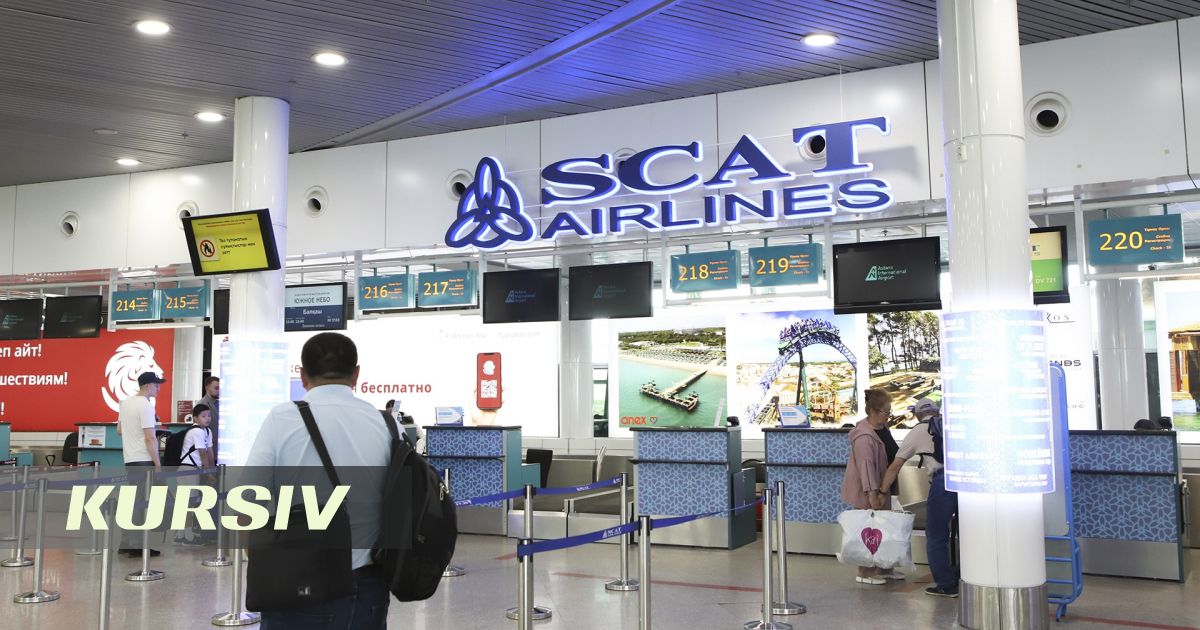
In 2025, SCAT Airlines reported a net profit of 39.3 billion tenge, while its main competitor Air Astana earned only 7 billion tenge. This was highlighted by Arman Batayev, author of the Finmentor.kz channel. Notably, SCAT's assets and revenue are more than twice as small as those of the country's leading airline, reports infohub.kz.
Economist Batayev compared the financial performance of Kazakhstan's two largest carriers over the past year. Despite SCAT's revenue being 2.4 times lower than Air Astana's (322.5 billion tenge vs. 759 billion tenge), the Shymkent-based airline outpaced its main rival in profit.
SCAT's net profit grew by 8% year-on-year to 39.3 billion tenge. In contrast, Air Astana earned 7 billion tenge, a 72.5% decrease from the previous year.
Thus, SCAT earned 5.6 times more despite lower revenue. Of the total, 311.7 billion tenge came from passenger traffic, 4.4 billion tenge from flight subsidies, and 4 billion tenge from cargo transportation.
SCAT's cost of services amounted to 270.6 billion tenge, administrative expenses to 5.6 billion tenge, and selling expenses to 16.6 billion tenge. Key cost items included fuel (84 billion tenge), airport services (46 billion tenge), materials and spare parts (27 billion tenge), and salaries (20 billion tenge).
For comparison, Air Astana spent 173 billion tenge on fuel—more than double SCAT's figure—136 billion tenge on personnel and crew, 76 billion tenge on maintenance, and 73.6 billion tenge on airport services.
Batayev also noted that SCAT's 2025 results were significantly boosted by a foreign exchange gain of 12.3 billion tenge. In contrast, Air Astana incurred a foreign exchange loss of 4 billion tenge.
Both companies saw increased debt due to leasing agreements and fleet expansion. Air Astana's leasing obligations reached 528 billion tenge, while SCAT's loans and leasing obligations grew to 238.1 billion tenge. SCAT's leased aircraft count increased from eight to nine in 2025.
Arman Batayev pointed out that SCAT's cash flow is more than four times smaller than Air Astana's—30.4 billion tenge vs. 128 billion tenge. Air Astana's assets (1 trillion tenge) are 2.5 times larger than SCAT's 411.9 billion tenge.
Nevertheless, SCAT ended 2025 with significantly higher net profit and profitability.
Earlier it was reported that the remuneration of Air Astana's board members in 2025 amounted to 691 million tenge, a 31.6% increase from the previous year. The board consisted of a single member—former CEO Peter Foster.