

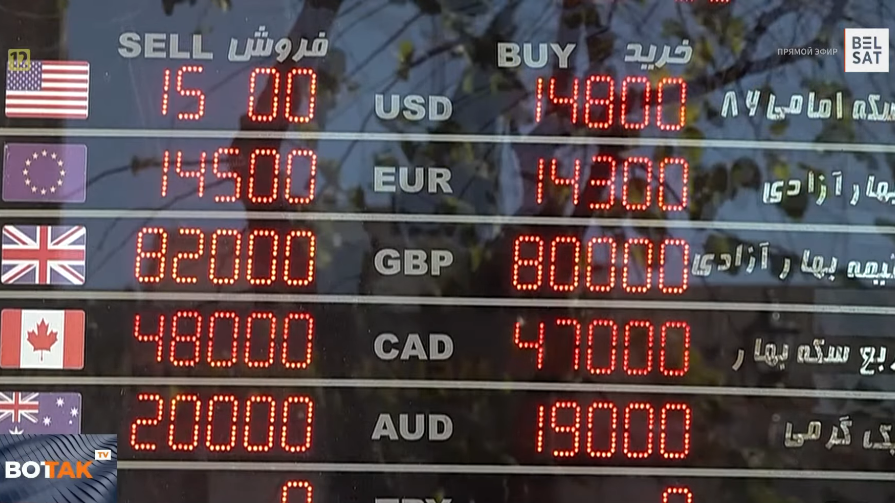
Mass protests that erupted across Iran in late December 2025 have entered a new phase, fueled by a collapsing rial and 72% inflation that are crushing household budgets and eroding long-standing pillars of state legitimacy. The stakes extend beyond Iran, with potential implications for regional stability and energy markets.
This was reported by the Infohub.kz news agency.
Currency crash, soaring prices
By the end of 2025, Iran’s rial sank to about 1 USD = 1.42 million rials on the informal market — an estimated 84% slide from December 2024. Roughly 56% of that decline occurred in just six months. For comparison, in 2018 the dollar traded near 50,000 rials.
The price shock has pushed daily necessities out of reach for many families, intensifying anger across social groups and weakening the government’s traditional support base.
Geopolitics and a fading narrative
Political analyst Sultan Akimbekov argues this wave differs from 2019 and 2022 because both Iran’s geopolitical environment and internal balance have shifted. He notes the “axis of resistance” — Tehran’s proxy network from the Levant to Yemen — looks strained.
The brief 12-day confrontation with Israel in 2025, he says, exposed the limits of Iran’s military-political reach. That has prompted public debate over the cost of external commitments while living standards at home deteriorate.
Elite rivalry and a delicate transition
Uncertainty around succession has sharpened elite competition. Speculation about Supreme Leader Ali Khamenei’s eventual successor — including talk around his son, Mojtaba Khamenei — has intensified maneuvering among power centers.
Meanwhile, President Masoud Pezeshkian, elected in July 2024 after defeating conservative Saeed Jalili, signaled voter appetite for a comparatively moderate course. The Islamic Revolutionary Guard Corps (IRGC), however, remains intent on protecting its institutions and influence.
How this wave differs from 2019 and 2022
The 2019 unrest began after gasoline prices jumped 50–200%, with Reuters later reporting up to 1,500 fatalities. In 2022, protests following the death of 23-year-old Mahsa Amini left more than 500 people dead, according to rights groups.
Today’s protests stand out for the visible participation of small bazaar merchants — traditionally a social pillar for the system — underscoring how economic pain has broadened discontent.
Heavy security presence, waning public support
Authorities have mobilized the Basij (roughly 100,000) and the IRGC (around 200,000) to contain the unrest, while trying to calibrate their response. As of January 6, 2026, rights defenders reported up to 35 deaths and about 1,200 detentions.
In some areas, security forces used live fire, while demonstrators reportedly hurled Molotov cocktails — signs of escalating confrontation and diminishing public patience.
Quick fixes: wage hike and VAT cut
On January 5, 2026, parliament revised the budget to raise public-sector salaries by 43% instead of the planned 20% and to cut VAT from 12% to 10%. The measures may temporarily calm civil servants and the bazaar.
Yet with inflation near 72%, the pay bump risks being erased quickly, limiting the policy’s ability to restore confidence.
The legitimacy test
Since the 1979 revolution, anti-U.S. rhetoric served as a unifying tool. After the 2025 flare-up, however, that message appears less persuasive — even among conservatives prioritizing economic survival. Tehran continues to warn against foreign interference, but the traditional “external threat” argument no longer guarantees mass mobilization.
With markets in turmoil and geopolitical constraints mounting, Iran’s decades-old legitimacy model — grounded in ideology and external resistance — is under acute strain. That makes the 2025–2026 unrest potentially more perilous for the system than previous waves.